July 30, 2026
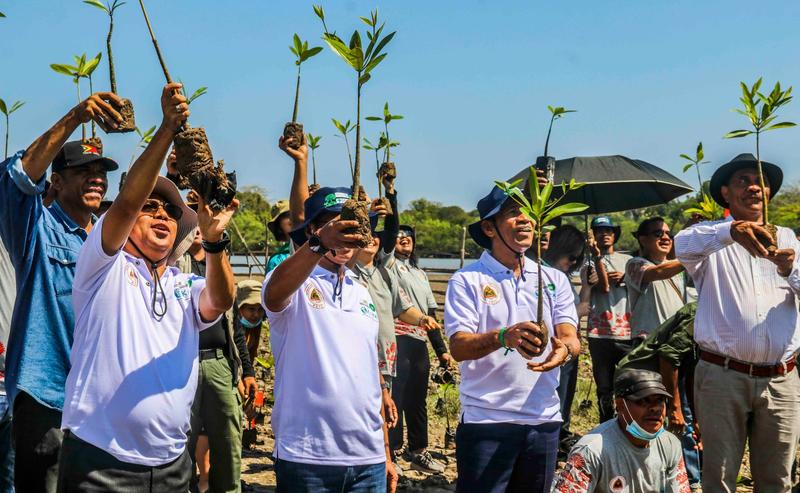
Bee Malae, Sanirin - Bobonaro, 28 July 2026
As part of the Celebration of World Mangrove Day (26 July 2026), Conservation International Timor-Leste (CI-TL), through the Kiwa RESTORE Project, in collaboration with the Secretary of State for Forests under Ministry of Agriculture, Fisheries, Livestock and Forestry (MAPPF), commemorated the day under the theme:
"Nature-based Solutions: Protect Mangrove Ecosystems through Local Knowledge to Restore Nature and Sustain Livelihoods."
The celebration, held on 28 July 2026, brought together Vice Prime Minister Mariano Assanami Sabino, government officials, municipal and local authorities, development partners (local, national and international NGOs), community leaders, students and local communities to plant 6,492 mangrove seedlings along the coastal area of Bee Malae, Sanirin Village, Bobonaro Municipality.
The activity reflects a shared commitment to protecting and restoring mangrove ecosystems, which play a critical role in conserving biodiversity, mitigating climate change and sustaining the livelihoods of coastal communities.
Mangroves provide essential natural protection against coastal erosion, storm surges and flooding. They also serve as important habitats for fish, crabs, birds and many other marine species, contributing to sustainable fisheries and food security for local communities.
In his remarks, Minister of Agriculture, Fisheries, Livestock and Forestry Marcos Maumeta emphasized the importance of collective action and stated, we must work together to protect, conserve and preserve our land, which is rich in biodiversity.
"We all recognize that World Mangrove Day is extremely important because forests are our source of life. Forests provide many benefits, including protecting our coastlines from erosion, large waves and natural disasters. One of the most valuable coastal forest resources is mangroves."
Mangroves perform many important functions, including acting as a natural barrier between the sea and the land and serving as natural filters that trap sediments carried by rivers during the rainy season. This helps keep coastal waters clean and provides healthy habitats for marine biodiversity, including fish, shellfish and other aquatic species.
Celebrating World Mangrove Day is an opportunity to remind everyone that protecting nature is not only the responsibility of the Government, but also of every citizen—from children to elders—as well as civil society organizations and non-governmental organizations.
The Minister encouraged communities to continue protecting the remaining mangrove forests, noting that scientific studies show mangroves have a remarkable capacity to absorb carbon and produce more oxygen than many other tree species.
"I encourage the people of Sanirin village to continue working together with the local government, the Ministry of Agriculture and development partners to protect the mangroves we have planted today along our coastline," he concluded.
The Government, through the Ministry of Agriculture, Fisheries, Livestock and Forestry, also reaffirmed its commitment to continue restoring and replanting mangroves in areas where mangrove forests have been degraded. Because mangroves are a natural shield for coastal communities.
By planting 6,492 mangrove seedlings in Bee Malae, all stakeholders are working together to restore nature, strengthen biodiversity and secure a better future for both present and future generations.
He added that restoring mangroves is more than planting trees; it is an investment in a resilient, sustainable future for Timor-Leste.
In his address, Vice Prime Minister Mariano Assanami Sabino appreciated Conservation International Timor-Leste and Country Director Manuel Mendes for their continued efforts to mobilize financial resources in support of the Ministry of Agriculture, Fisheries, Livestock and Forestry, particularly in strengthening forest conservation initiatives.
The Prime Ministry represents also encouraged the Ministry of Agriculture, together with the Secretary of State for Forests and Fisheries, to continue working closely with communities—not only to celebrate important environmental events such as World Mangrove Day, but also to ensure these initiatives contribute directly to improving community livelihoods.
He further emphasized: "It is critically important that we restore and protect our forests, water resources and oceans because they are the foundation of our lives."
The Ministry of Agriculture, Fisheries, Livestock and Forestry also expressed its appreciation for the strong collaboration between the Government, development partners and local communities in promoting natural resource conservation. The Government continues to encourage communities to actively participate in the protection and sustainable management of mangrove ecosystems.
Through the Kiwa RESTORE Project, Conservation International Timor-Leste is implementing mangrove restoration activities in Bobonaro Municipality (Batugade, Sanirin and Biacou) and Liquiçá Municipality (Ulmera). These activities include mangrove nursery development, mangrove planting, community capacity building, and environmental education programs for schools and local communities.
Celebrated annually on 26 July, World Mangrove Day provides an important opportunity to raise public awareness of the value of mangrove ecosystems and the urgent need to protect them from threats such as deforestation, pollution and climate change. The celebration in Bee Malae reinforces the message that conserving nature requires collaboration among government institutions, civil society organizations, the private sector and local communities.
CI-TL reaffirms its commitment to continue working with partners to restore degraded ecosystems, conserve biodiversity and strengthen the resilience of communities throughout Timor-Leste.
About Conservation International Timor-Leste
Conservation International Timor-Leste (CI-TL) works in partnership with the Government, local communities, development partners and the private sector to protect nature, conserve biodiversity and promote sustainable development. Through its terrestrial and marine conservation programs, CI-TL supports ecosystem restoration, climate change mitigation and improved livelihoods for communities that depend on natural resources.